Product Category

Hollow Plunger Cylinders

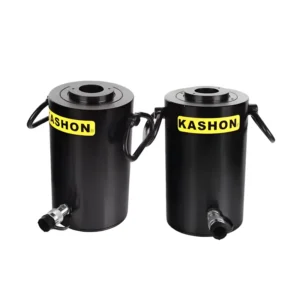
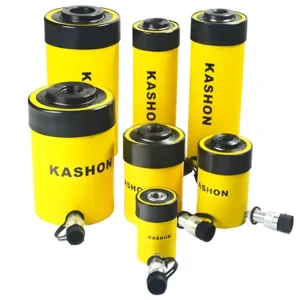
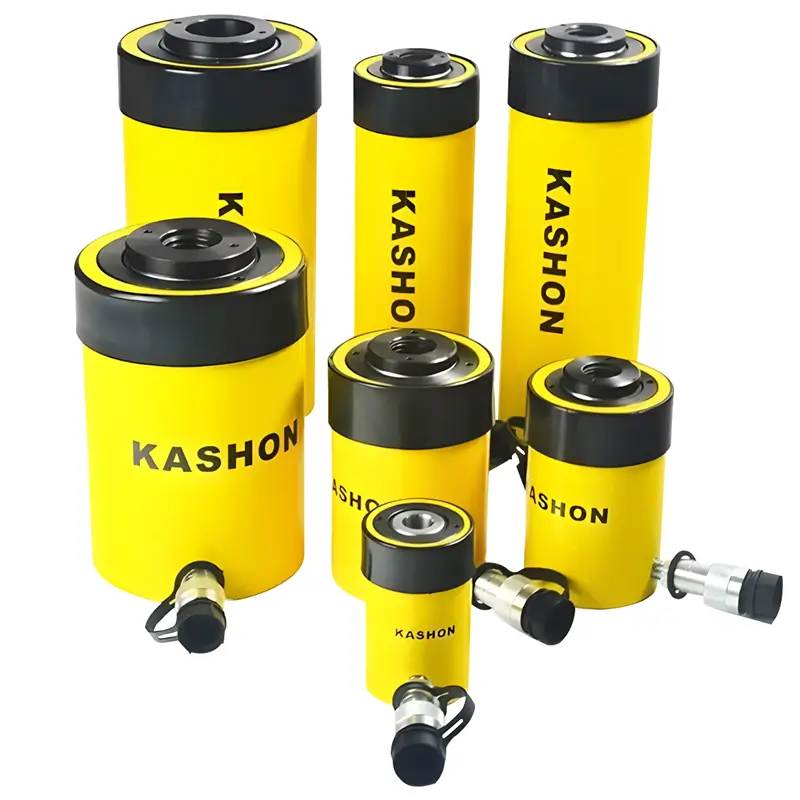
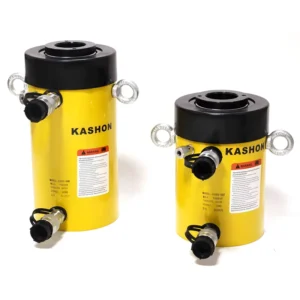
Kashon hollow plunger cylinders with a center-hole for push and pull pressures are needed for tensioning, testing, heavy pulling and assembling. We have high strength steel or lightweight aluminum single and double acting variants.

Typical applications are anchoring under tension, pulling bushings and bearings, tensioning threaded bars and for assembly/disassembly work in machine and plant engineering.

ISO 9001
TÜV Certified
Hollow Plunger Cylinders
Browse All Models

PRODUCT
LINEUP

3 Products Available
RRH Series, Double-acting Hollow Plunger Cylinder
RRH

RRH Series, Double-acting Hollow Plunger Cylinder

The RRH-Series Double Acting Hollow Plunger Cylinder boosts speed with its double-acting design and adds versatility with its hollow plunger. Multiple safeguards—including a corrosion-resistant finish, a nickel-plated tube, a relief valve, and a plunger wiper—ensure maximum durability and safety.

RACH Series Hollow Plunger Aluminum Cylinder
RACH

RACH Series Hollow Plunger Aluminum Cylinder

RACH-Series single-acting hollow plunger cylinders are a lightweight, portable alternative for pulling and tensioning. The hollow construction allows for easy attachment and a spring allows for quick retraction. Made of anodized aluminum with steel base and saddle, good corrosion resistance and long service life.

  • Capacity: 555
  • Stroke: 50-250mm
  • Pressure: 70Mpa
RCH Series Single-acting Hollow Plunger Cylinder
RCH

RCH Series Single-acting Hollow Plunger Cylinder

The RCH Series Hollow Plunger Cylinders are a robust, high-performance solution for applications that demand power and precision. Their single-acting, spring return design ensures fast, simple retraction, while the hard chrome-plated plunger provides superior wear and corrosion resistance.

  • Capacity: 555
  • Stroke: 16-260
  • Pressure: 700BAR/10000PSI
Technical Overview

HOW DOES IT WORK?

Working principle diagram
Principle Explained

How does hollow plunger cylinder work?

Kashon’s hollow plunger (or center-hole) cylinders are built for strength in pushing and pulling.

Its core design features a plunger with a central through-hole. When hydraulic pressure is applied, the plunger extends to directly push the load, creating a pushing force. For pulling operations, threaded rods or cables can pass through the center hole and be fixed to the plunger’s internal threads, thereby converting the extension stroke into a powerful pulling or tensioning force.

Available Models:

  1. Single-Acting: Hydraulic extension, spring or load assisted return.
  2. Double Acting: Full hydraulic control for both extension and retraction for quicker, more precise cycles.

Available in steel or aluminum alloy with features like changeable saddles and base plates to customize to your project’s requirement.
Why Choose This Series

CORE ADVANTAGES

CENTER-HOLE VERSATILITY

Our signature hollow-bore design allows rods and cables to pass through the cylinder’s center, enabling advanced pulling, pushing, and tensioning applications.

DUAL-FUNCTION POWER

Engineered to perform both push and pull operations with a single tool. This streamlines your workflow, saving time and reducing the number of tools required on site.

COMPACT & POWERFUL

Delivers maximum force from a minimal footprint. The efficient design makes it perfect for operations in confined spaces where conventional cylinders won't fit.

ULTIMATE PORTABILITY

Constructed from high-strength, lightweight materials, these cylinders are easy to transport and position, making them the ideal choice for mobile maintenance and field repairs.

PRECISION AXIAL FORCE

Force is applied directly through the central axis, ensuring perfectly centered, balanced loads. This improves accuracy and prevents damaging side-load forces.

MODULAR & ADAPTABLE

A wide range of accessories for pulling and tensioning transforms this cylinder into a complete, modular solution for countless industrial and construction tasks.

Tailored Engineering

CAN'T FIND THE PERFECT MATCH?
GET YOUR CUSTOM SOLUTION

Our engineering team specializes in designing bespoke hydraulic solutions tailored to your exact application requirements -- from unique tonnage ratings to specialized environmental conditions.

  • Custom tonnage, stroke & bore specifications
  • Special material & surface treatment options
  • Application-specific pressure ratings
  • Full technical drawings & documentation
  • ISO 9001 quality assurance throughout
Custom Solution
Support

COMMON QUESTIONS

Find answers to the most frequently asked questions about this product series.

The main advantage of the hollow plunger design is functional integration. The central axis of the cylinder can be used to directly transmit components such as threaded rods, wires, pull bars, or even sensors. This allows the cylinder to execute complex tasks such as tensioning, anchoring, synchronized testing or real-time monitoring, while at the same time providing tremendous pushing or pulling forces, thereby greatly increasing its scope of application.

The choice will rely on your particular application. Single action cylinders are more simple and economical. They are extended by hydraulic pressure and retracted by an internal spring, or by the weight of the load itself. They are well suited for one-way applications such as lifting or disassembly when frequent back-and-forth action is not required.
Hydraulically powered double-acting cylinders extend and retract, providing faster response times and more precise control. This makes them ideal for automated or high-frequency applications that require rapid back-and-forth movement and precise positioning.

Steel hollow plunger cylinders provide greater strength and impact resistance, and are therefore suitable for heavy-duty, fixed-installation or harsh environment applications. Their principal disadvantage is their great weight. Aluminum cylinders on the other hand are made to be portable and low weight.
They are substantially lighter than comparable steel products, ideal for transportable applications such as site maintenance, frequent moves or working at height. The surface is also usually hard-anodized for improved corrosion protection.

This duality of function is due to its unusual hollow plunger construction. If it is a pushing force it behaves like a normal cylinder, with the plunger extending under hydraulic pressure to push a load.
A threaded rod or bar is passed through the centre hole to provide a pulling force and is screwed into the internal threads or the end of the plunger. The plunger extends , pulling this rod along with it . That ‘s a strong pull in the axial direction .

Yes. To make sure the action is smooth and to reduce wear, lubricate the contact surface between the plunger and the cylinder body from time to time. It is also recommended that, for long periods of time when a component is mounted via the center bore, an anti-wear lubricant be applied to the inner wall of the hollow channel. This avoids dry friction, preserves the internal route from wear and improves the total life of the cylinder.

Choosing the correct hollow bore diameter is critical; it must be large enough to allow your specific rod, cable, or sensor to pass through smoothly with adequate clearance. The stroke length must be sufficient to cover the full travel distance required for your push or pull operation.

An insufficient stroke will prevent the job from being completed, while an excessive stroke could risk plunger instability in certain applications. When selecting, you must also ensure the cylinder’s rated capacity (tonnage) and pressure meet your load requirements, ideally with a safety margin of about 20%.

Still Have Questions?

Our technical team is ready to help with any product inquiries.